
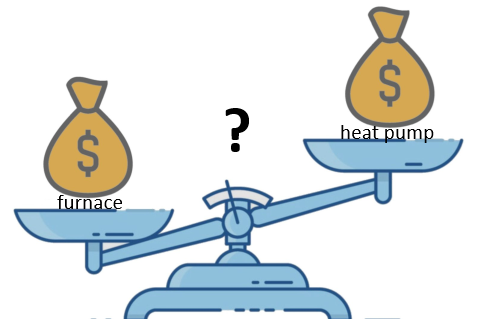
Affordability is of course a primary concern in decisions like what to heat your house with, as heating bills can put a substantial dent in anyone’s budget. And – good news! — the marketing of heat pump installers insists that you’ll save money on your heating bills. But you’re skeptical (and so am I)! So, let’s look at the numbers on this… The affordability of heating with an air-source mini-split heat pump will depend on what your current heating system is. To figure out what you’ll likely pay per year with a new mini-split system, all you need is:
- a good estimate of the % efficiency of your current system (typically on that yellow-background sticker that is attached to it!)
- your last year of utility bills (or other fuel bills if heating with oil, propane, coal, wood, or wood pellets).
- An estimate of the Seasonal Coefficient of Performance (SCOP) of your new air-source heat pump.
- An estimate of the total price per KWh that you’ll pay to your utility company over the next year.
The formula for estimated annual heating cost with a new heat pump is:
(# of units of fuel) x (KWh/unit of fuel) x (total price per KWh) x (efficiency of old heating system)
(Seasonal COP of new heat-pump)
Where:
- # of units of fuel – how many ‘units’ of fuel used to heat your house in the past year? ‘Units’ can be therms of natural gas, or gallons of heating oil or propane, or cords of wood, or pounds of wood pellets…
- KWh/unit of fuel for various fuels:
- Natural Gas: 29.3 KWh/Therm
- Heating Oil: 41.0 KWh/gallon of #2 oil
- Propane: 27.99 KWh/gallon of LPG
- Wood: ~3,700 – 5,800 KWh/cord, assuming 20% moisture, depending on species
- Wood pellets: ~4.9 KWh/kg
- total price per KWh – assessing this cost for the next year of heating with a new heat pump requires a bit of extrapolation from your previous year of utility bills, as typically the electricity price fluctuates throughout the year. You could just get the total amount charged for the electricity portion of the year of bills (including supply AND delivery), and divide it by the total number of KWh consumed over the same year of bills. You could add an ‘inflation adjustment’ to this estimate, if you’d like…
- Seasonal COP (SCOP) of new heat pump — Figuring out the SCOP of your new heat pump is also not an exact science, since the efficiency information for a new heat pump is typically given at only 2 specific temperatures (47 degrees F and 5 degrees F) via its “submittal data sheet”. However, if your heat pump manufacturer provides an ‘HSPF’ or ‘HSPF2’ value, you can calculate your SCOP from that. Ideally, you’ll have an ‘HSPF2’ value for your specific climate zone (which you can find on this handy map) To calculate the SCOP for your climate zone from the HSPF2, first divide the HSPF2 by 0.85 to get the corresponding HSPF value, and then multiply that by 0.293 to get the SCOP.
Once you have calculated the $ amount of the above formula, you can compare it to your cost of fuel for the previous year…. Here’s one example (mine!). It’s a ~2,000 square foot house, fairly insulated and located in upstate NY, partially heated with natural gas, using a furnace that is now 21 years old. I’m looking to install a 49,000 BTU/hr five-zone mini split heat pump from a company called ACiQ. (The associated submittal data sheet is here.) Formula for my house:
- # of units of fuel: 440 Therms
- KWh/unit of fuel: 29.3 KWh/Therm
- Anticipated total price per KWh: $0.223
- Efficiency of old heating system: 90%
- Anticipated SCOP of new heat pump: HSPF2 for climate zone 5 is 7.6, and so corresponding HSPF value is 7.6 / 0.85 = 8.54; and 8.94 x 0.293 = 2.62; that’s the SCOP…
- (440 therms) * 29.3 KWh/therm) x ($0.223/KWh) x 0.90 / 2.62 = ~$988 is what I expect to spend in the first year of heating with a new heat pump.
Reviewing my last year of utility bills, I was easily able to determine the total cost of the natural gas used for heating — since I only use natural gas for heating; not for stove/oven, hot water, clothes drying, or a gas fireplace. (If you use natural gas for these other uses, you’ll likely have to make an estimate here about how much was used for heating…) That cost was $663. Also adding in the cost of the electricity to run my furnace (which I was able to assess since I use an Emporia Vue home energy monitor to monitor the electricity used by each “important” circuit in my house), I established the additional cost was $162. So, the total cost to heat the house with natural gas last year was $825.
Hmmm… Apparently, it will cost me $163 more to heat my house with the heat pump versus what it cost to heat the previous season with natural gas. But hold on a second here 🙂 I had changed my electricity supplier to the 100% renewable plan from Energy Cooperative of America. And that is costing me ~4 cents per KWh extra. Since I’ve signed up for Community Solar, and since I’m eliminating my direct burning of natural gas by moving to the heat pump, I feel ok with switching my electricity supplier back to my utility company, which has a plan that gives me a substantial discount for electricity used between 11pm and 7am (which is when I charge the electric car). Based on this new plan, with a conservative estimate of a 5 cents per KWh discount from the previous plan, the new estimate for the first year of heating with a new heat pump is $766, which is $59 less than last year’s cost of heating with natural gas.
Based on this analysis (which is very specific to my situation, so your analysis may certainly come to a different conclusion), the heat pump will not ‘break the bank’ for the yearly heating bill, and should actually save a little money, and so I’m going to proceed with the purchasing and installing the new heat pump! (Note – on the purchase and installation front – I’m planning to do almost all the work myself, to reduce the cost, making it less expensive (after the tax credit) than the cost of having an HVAC contractor replace the gas furnace with a new furnace and central air system. I’ll share more on how the project goes in future posts…)