
It’s the big decisions in life that really affect our global warming footprint, and certainly the choice of a home heating system in a state such as New York qualifies as a big decision. Once you’ve subscribed to a community solar farm, and switched to a renewable electricity provider, you’ve ensured that heating your home with electricity will have a very low carbon dioxide emissions level.
But ‘resistance’ heating with electricity will cost way more than heating with natural gas, simply because new gas furnaces are ~95% efficient, whereas with electricity generated by combined cycle gas turbine (CCGT) power plants, their efficiency (~55%) along with grid losses (~3%) results in a best case of just ~52% of the energy from natural gas being delivered to your house in the form of electricity. And oil or coal fired power plants have worse efficiency than CCGT’s. With electricity pricing based on the cost of the input fuels, you can see how gas furnaces would cost less to operate than ‘resistance’ heating with electricity.
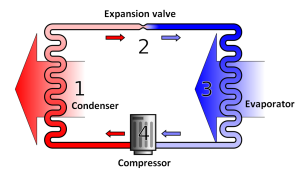
Fortunately, heat pumps (including ‘mini-splits’ and ‘geothermal’ units) have always provided better efficiency than ‘resistance’ heating — and their technology has progressed substantially over the years. With mini-splits, the refrigerant absorbs heat from the air outside your house, and modern mini-split heat pumps will operate down to temperatures of -13 to -22 degrees Fahrenheit. Unfortunately though, many heat pumps put out fewer BTU’s per hour at the lowest temperatures (when you actually need the maximum BTU’s per hour). Below their minimum operating temperatures, depending on the model, they will either stop running or switch to resistance heating. If you select a heat pump that stops at temperatures below its minimum operating temperature, and you live in an area where temperatures go lower than that (choose ‘temperature graphs’ here for your location to see the ‘normal’ and ‘record’ low temperatures each day of the year), then a backup heating option for the very coldest nights — either your existing furnace, or your existing electric stove/oven, or perhaps a wood stove or wood pellet stove — might be good for piece-of-mind.
With geothermal heat pumps, the refrigerant absorbs heat from a fluid that is run through pipes hundreds of feet underground, where the temperature is somewhat constant — for example, in New York state it is typically ~49 degrees Fahrenheit. Since it is easier to warm refrigerant with the ~49 degrees fluid than it is to warm refrigerant with air at typical New York winter temperatures, the geothermal heat pump is substantially more efficient than the mini-split, even given the added energy to pump the heat transfer fluid through the underground pipes.
A gauge of the efficiency of a heat pump is the ‘seasonal coefficient of performance’ (SCOP). This is a number which indicates how efficient the heat pump is over the entire heating season. If the number were ‘1.0’, that would indicate 100% efficient, similar to resistance heating. If the number is ‘2.0’, then the system uses half the electricity of a resistance heating system. In New York state, the best mini-split heat pumps may have an SCOP of ~2.7 to 2.9. Geothermal heat pumps will typically have an SCOP of ~3.7 to 4.0. To see how to predict your annual heating bill when switching to a mini-split heat pump, take a look here.
Another difference between mini-split heat pump systems and geothermal systems is that the latter require ducting to be available throughout the house. And so, if you currently have electric resistance heating for all or part of your home, this will increase the cost of a geothermal solution considerably. And that is beyond the substantial additional cost of the geothermal system’s “ground loop”.
That said, if you can install a heat pump system (either mini-split or geothermal) into your house when your current system needs replacing, you will be reducing your home’s global warming footprint by a large amount — a typical 2000 square foot home in New York might release 2.5 to 3.0 tons of carbon dioxide per year from natural gas heating. So take a good look at this option — with the tax incentives now in place at the state and federal level, it can be a very compelling option. (Interestingly, even heating fuel delivery companies are getting into the action, with services for installation of mini-split heat pumps!)
More information on choosing a heat pump in New York State is available here. If you proceed with this project, be sure to get at least 2 quotes, and beware of contractors who are opportunistically charging excessively high prices.